



Developing Java Beans
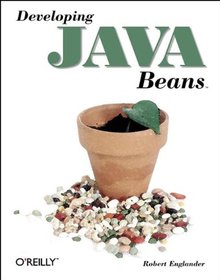
Book Details:
| Publisher: | O'Reilly Media |
| Series: | OReilly |
| Author: | Robert Englander |
| Edition: | 1 |
| ISBN-10: | 1565922891 |
| ISBN-13: | 9781565922891 |
| Pages: | 320 |
| Published: | Jun 08 1997 |
| Posted: | Nov 19 2014 |
| Language: | English |
| Book format: | |
| Book size: | 1.37 MB |
Book Description:
Java Beans is the most important new development in Java this year. Beans is the next generation of Java technology that not only adds features the language lacked, but also lets Java programs interoperate with a number of development environments. The initial release includes a bridge for Microsoft's ActiveX/COM; future releases will include bridges for Netscape's LiveConnect and IBM's OpenDoc.Since it's a "component architecture" for Java, Beans can be used in graphical programming environments, like Borland's JBuilder, or IBM's VisualAge for Java. This means that someone can use a graphical tool to connect a lot of Beans together and make an application, without actually writing any Java code -- in fact, without doing any programming at all. Graphical development environments let you configure components by specifying aspects of their visual appearance (like the color or label of a button) in addition to the interactions between components (what happens when you click on a button or select a menu item).One important aspect of Java Beans is that components don't have to be visible. This sounds like a minor distinction, but it's very important: the invisible parts of an application are the parts that do the work. So, for example, in addition to manipulating graphical widgets, like checkboxes and menus, Beans allows you to develop and manipulate components that do database access, perform computations, and so on. You can build entire applications by connecting pre-built components, without writing any code.Developing Java Beans is for people who need to stay up-to-date with the latest developments in programming technology. Minimally, developing Beans means adopting several simple design patterns in your code. However, that's only the beginning. To take full advantage of the Java Beans architecture, you should understand how to write classes that are serializable, use events for communication between classes, know when and how to provide BeanInfo classes that give graphical environments more information about your components, and provide property editors and customizers that let graphical tools work with more complex Beans.The book covers:Events, event listeners, and adapters Properties, indexed properties, bound properties, constrained properties, and vetoable property changes Persistence, serialization, versioning, and object validation Packaging Beans using JAR files The BeanBox, a prototypical development tool Reflection and introspection Property editors and customizers The ActiveX bridge; using Java Beans in Visual Basic programs
Download Link:
Related Books:
EJB 3 Developer Guide
A Practical Guide for developers and architects to the Enterprise Java Beans Standard.
In Detail The EJB 3 (Enterprise Java Beans version 3) specification is a core component of enterprise-level JEE (Java Platform Enterprise Edition) implementations and this improved version is set to simplify the development of Enterprise Java applications. This book covers the core elements of EJB 3 technology, exploring them in a concise manner with many supporting examples. You will gain a thorough understanding of EJB 3 technology and learn about the most important features of EJB 3 quickly. What you will learn from this book? This book will teach you the core elements of EJB 3 technology. You will:Gain a rapid introduction to the EJB 3 essentials while learning about the underlying principlesCreate Entities, Message-Driven Beans, Session Beans a...
Developing Java Web Services
Architecting and Developing Secure Web Services Using Java
One of the first books to cover Sun Microsystem's new Java Web Services Developer PackWritten by top Sun consultants with hands-on experience in creating Web services, with a foreword from Simon Phipps, Chief Evangelist at SunCase studies demonstrate how to create Web services with the tools most used by Java developers, including BEA WebLogic, Apache Axis, Systinet WASP, and Verisign...
Wireless Java
Developing with Java 2, Micro Edition
The first book that uses the current version of J2ME to give real code for real applications, including extensive coverage of the new and exciting concept of MIDIlets. Jonathan Knudsen is one of the leading authors in the Java space. Softcover....
2007 - 2021 © eBooks-IT.org